
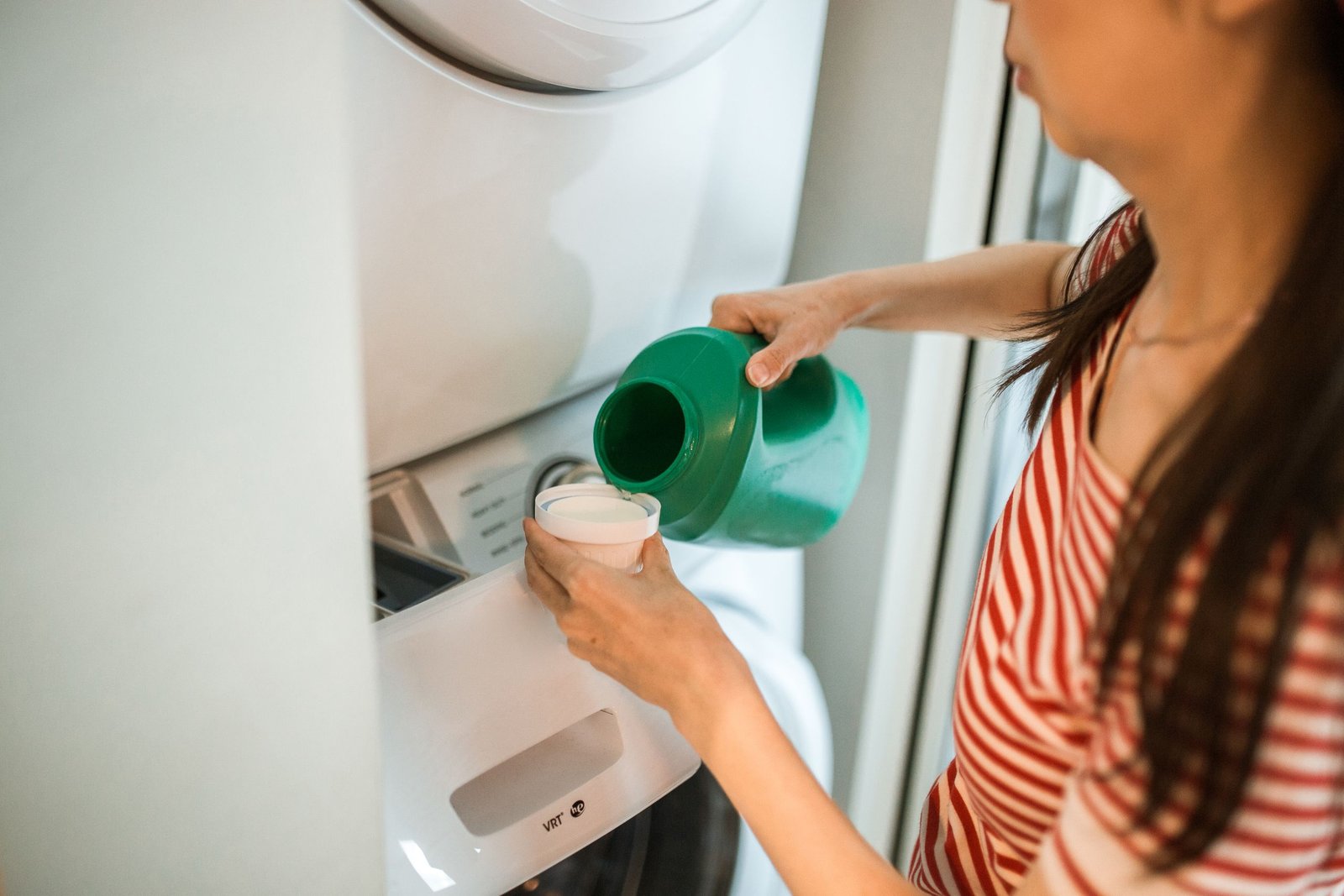
Every piece of clothing, every set of sheets, every towel passes through laundry products before coming into sustained contact with skin. It’s one of the highest-frequency product categories in the home — used multiple times a week, across every textile that touches the body — and most people have never read the ingredient list of their detergent. Partly because full disclosure isn’t required. Partly because the front of the package does enough work that the back rarely gets read.
This article covers what’s actually in conventional laundry products — what the compounds do, what the research links them to, and what stays on fabric after the wash cycle is done.
Why Laundry Product Labels Are Incomplete
Laundry detergents fall under the same regulatory framework as other household cleaning products — the Federal Hazardous Substances Act — which requires hazard communication and safety information but does not mandate full ingredient disclosure. As covered in How to Read a Cleaning Product Label, manufacturers aren’t required to list every ingredient in a cleaning product the way food manufacturers are required to list every ingredient in a food product.
What this means in practice is that a conventional laundry detergent can contain dozens of individual compounds — surfactants, fragrance components, optical brighteners, preservatives, and processing aids — and be legally required to disclose only a fraction of them on the label. “Surfactants,” “fragrance,” and “enzymes” can each appear as single entries covering multiple undisclosed compounds.
The EPA’s Safer Choice program and voluntary disclosure initiatives from some brands fill part of this gap — but for most conventional products, the label tells you less than it appears to. Understanding what the common ingredient categories actually contain is the more useful starting point.
What’s Actually in Conventional Laundry Detergent
Conventional laundry detergents are complex formulations built from several ingredient categories — each performing a specific function in the wash cycle and each with its own profile worth knowing.
Surfactants are the primary cleaning agents — compounds that reduce the surface tension of water, allowing it to penetrate fabric and lift dirt and oils away. Most conventional detergents use petroleum-derived surfactants, including linear alkylbenzene sulfonates and alcohol ethoxylates. They’re effective at cleaning but can be persistent in aquatic environments after they go down the drain, and some have been associated with skin irritation and sensitization with repeated contact.
Synthetic fragrance is present in most conventional laundry detergents and is specifically formulated to linger on fabric after washing — the characteristic “clean laundry” smell that persists through drying and wearing is the intended outcome of fragrance compounds designed for fabric retention. As covered in What “Fragrance” on a Label Actually Means, the single word “fragrance” covers a potentially complex blend of undisclosed compounds including sensitizers, synthetic musks, and endocrine-disrupting chemicals. In the laundry context, these compounds don’t just contact skin briefly — they remain on every garment and piece of bedding washed with the detergent, in sustained contact with skin through the day and night.
Optical brighteners are fluorescent compounds added to make fabrics appear whiter and brighter under ultraviolet light. They work by absorbing UV radiation and re-emitting it as visible blue light — an optical effect rather than a cleaning function. They’re designed to stay on fabric rather than rinse out, which means they’re present on skin throughout the wear cycle. Some optical brighteners have been associated with skin sensitization and photosensitivity reactions, and they’re poorly biodegradable — persisting in aquatic environments after washing.
Enzymes are used in modern detergents to break down specific types of stains — proteases for protein-based stains, lipases for fat-based stains, amylases for starch-based stains. They’re generally considered effective and lower concern than some other detergent ingredients at typical use concentrations. Dubos documented toxic factors in laundry product enzymes as early as 1971, noting that certain enzyme preparations raised respiratory and sensitization concerns — a finding that informed subsequent formulation standards for enzyme-containing products. At normal laundry use, the relevant exposure concern is inhalation of detergent powder or concentrate during pouring rather than skin contact through washed fabric.
Preservatives prevent microbial growth in liquid detergent formulations during storage. The same preservative classes that appear in personal care products — methylisothiazolinone, benzisothiazolinone, and formaldehyde-releasing compounds — appear in some conventional liquid detergents. Methylisothiazolinone in particular has been associated with significant rates of contact sensitization — a concern that’s relevant when the preservative remains in trace amounts on fabric after washing.
The toxicity profile of conventional laundry detergent compounds is worth understanding at a baseline level. Riella et al.’s case report documented renal cortical necrosis following laundry detergent ingestion — an extreme exposure scenario, but one that illustrates the acute toxicity potential of the compounds present in conventional formulations. Normal laundry product use doesn’t involve ingestion, but it does involve repeated skin contact through fabric residue, inhalation during product handling, and potential hand contact during laundry sorting — exposure routes that are lower level but sustained across years of regular use.
Fabric Softeners — What’s in Them and Why They Stay on Fabric
Fabric softeners are formulated with a specific goal — to coat fabric fibers with compounds that reduce static, soften texture, and add scent in a way that persists through wearing and washing. That persistence is the product’s primary function. It’s also what makes its ingredient profile particularly relevant to sustained skin exposure.
The primary softening agents in conventional fabric softeners are quaternary ammonium compounds — the same quat class covered in the cleaning product label article. In fabric softeners, quats are used at concentrations specifically designed for fabric retention — they bind to fiber surfaces through electrostatic attraction and remain on the fabric after rinsing. Research has linked quaternary ammonium compounds to respiratory sensitization, skin irritation, and reproductive effects at sustained exposure levels — concerns that are relevant when these compounds are present on every garment and piece of bedding in regular rotation.
Synthetic fragrance in fabric softeners is formulated for even greater longevity than in detergents — the goal is a scent that’s detectable through the full wear cycle and into subsequent washing. The fragrance compounds used for this purpose are specifically selected for fabric adhesion and slow release — properties that maximize their presence in sustained contact with skin. As with detergent fragrance, the individual compounds within the “fragrance” entry aren’t disclosed.
Emulsifiers and stabilizers keep the fabric softener formula stable during storage — some of these are the same compound classes that appear in personal care products, including certain ethoxylated compounds that can be contaminated with 1,4-dioxane as a manufacturing byproduct.
Dryer Sheets — A Closer Look
Dryer sheets deliver fabric softening and fragrance through a different mechanism than liquid softeners — a nonwoven sheet impregnated with softening compounds and fragrance that transfer to fabric through heat and friction during the drying cycle. The heat involved is significant — it drives the transfer of compounds from the sheet to the fabric and also volatilizes fragrance and other compounds into the dryer exhaust.
Research has detected VOCs in residential dryer exhaust including acetaldehyde and benzene — compounds originating from the fragrance and treatment chemicals in dryer sheets and detergents as they’re heated during the cycle. These compounds are exhausted through the dryer vent — primarily to the exterior in most home setups — but the vent connection, lint trap area, and any duct leakage release compounds into the laundry room during operation.
The fabric residue from dryer sheets is similar in character to liquid softener residue — softening compounds and fragrance chemicals designed to stay on fabric. What’s distinctive about dryer sheets is the heating step, which accelerates transfer and ensures a more thorough coating of fabric surfaces with the sheet’s compounds than would occur through a rinse-cycle application alone.
What Stays on Fabric After Washing
The most significant aspect of laundry product exposure — what distinguishes it from other cleaning product categories — is what remains on fabric after the wash and dry cycle is complete.
Optical brighteners are designed not to rinse out. Fragrance compounds in both detergent and fabric softener are formulated for fabric retention. Quaternary ammonium compounds from fabric softener bind electrostatically to fiber surfaces. Preservative trace amounts can persist in fabric after washing. The combined residue from a full wash and dry cycle with conventional products is present on every garment and piece of bedding through its full period of use — against skin for hours at a time, day and night.
Yin et al.’s 2025 research on nanoplastics released from textile washing adds another dimension to the laundry exposure story — finding that washing releases not only microplastic fibers from synthetic textiles but nanoplastic particles that carry antibiotic resistance genes into sewage sludge microbiomes. This finding connects the laundry process to the broader antibiotic resistance concern — a public health dimension of synthetic textile washing that extends beyond the individual exposure question into environmental health.
The cumulative picture of what laundry products leave on fabric — fragrance compounds, optical brighteners, quat residues, and in the case of synthetic textiles, nanoplastic particles — is a more significant sustained exposure than the weekly wash cycle suggests when evaluated product by product.
What to Look for in Safer Alternatives
The alternatives that address the most significant laundry product exposure categories are increasingly available and practical.
Fragrance-free, dye-free laundry detergent is the single most impactful swap — eliminating the fragrance compound residue that persists on fabric and the optical brighteners that remain through the wear cycle simultaneously. Fragrance-free formulations exist across a range of price points and perform equivalently to scented alternatives for cleaning function.
EPA Safer Choice certified detergents have been evaluated for ingredient safety across the full formulation — covering surfactants, preservatives, and other ingredients that conventional detergents aren’t required to disclose. The Safer Choice database is searchable and allows specific product verification before purchasing.
Wool dryer balls replace dryer sheets and liquid fabric softeners with a residue-free alternative that reduces static and drying time through physical action — no compounds transferred to fabric, no VOC emissions from dryer exhaust, reusable for several years. They represent a complete elimination of the fabric softener exposure category rather than a reformulation of it.
Washing bags — fine-mesh bags like the Guppyfriend — reduce nanoplastic and microplastic fiber release from synthetic textiles during washing, addressing the environmental and potential personal exposure concern that natural fiber alternatives don’t fully eliminate until the synthetic garments are replaced.
GOTS certified detergents — where available — provide organic ingredient sourcing as part of the standard, adding a layer of agricultural and processing transparency beyond what EPA Safer Choice covers.
What Every Wash Leaves Behind
Laundry products are unique in the household product landscape because their residue doesn’t leave the home when the cleaning is done — it stays on the textiles that remain in sustained contact with skin. The fragrance compounds, optical brighteners, and fabric softener residues in a conventional laundry routine are present on clothing worn for hours, on sheets slept in through the night, and on towels used against skin after every shower.
Knowing what those compounds are, what the research links them to, and what stays on fabric changes what a routine laundry choice actually represents. The alternatives are practical, increasingly available, and address the exposure categories that matter most — without requiring any change to the laundry routine itself beyond what goes in the drum.
The references used in this article are a starting point — we encourage you to read further and draw your own conclusions.
The framework is one piece of the picture. Browse our Conscious Home articles to build on what you know — and make more informed choices about what you bring into your space.

Leave a Reply