
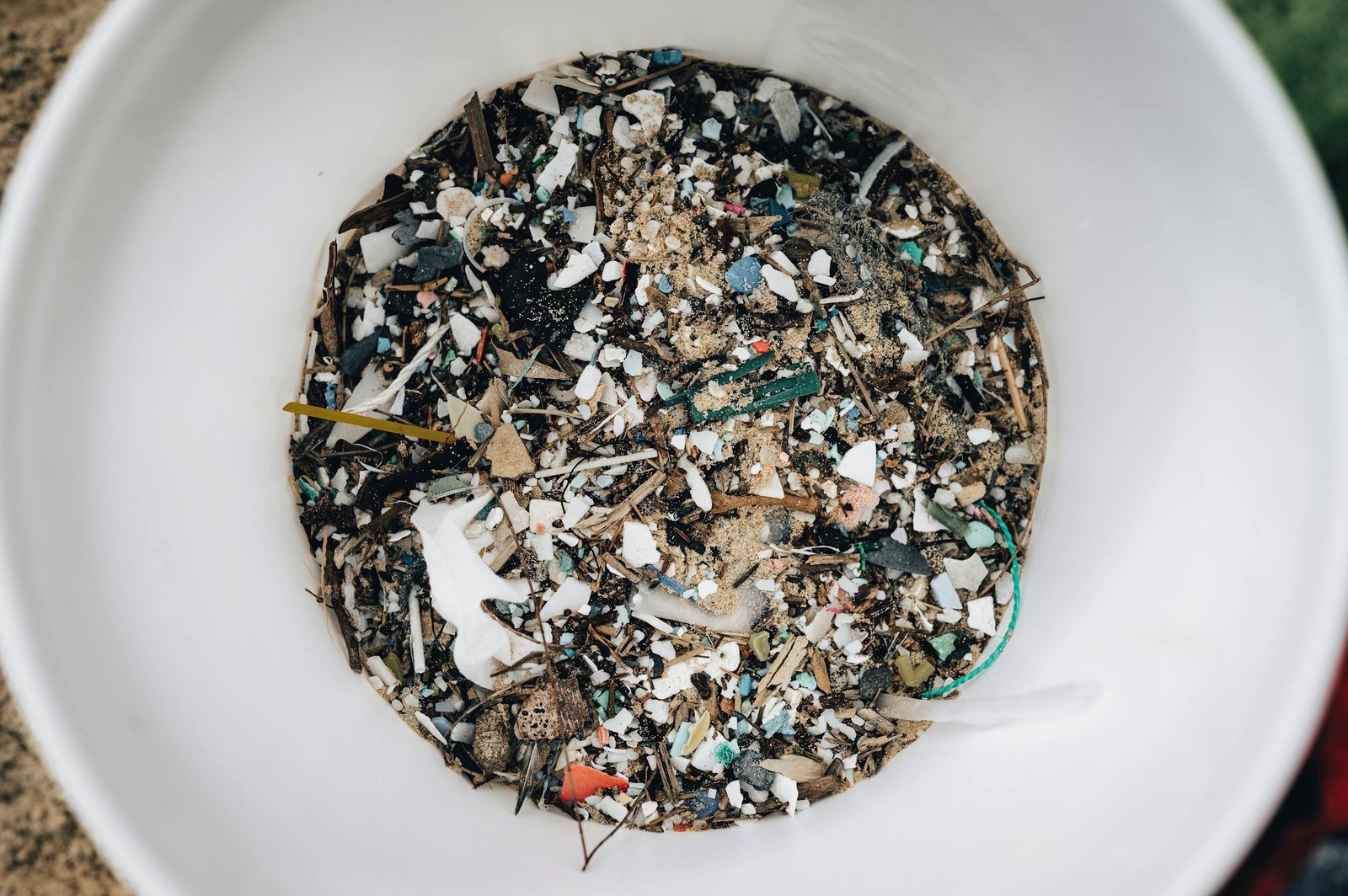
Plastic is designed to last. That’s what makes it useful — and what makes it a problem. When plastic breaks down in the environment, it doesn’t disappear. It fragments into smaller and smaller pieces over time, becoming particles so tiny they can’t be seen with the naked eye. Those particles are now found in the ocean, in soil, in the air, in food and water — and in the human body.
This is the microplastics story. It’s not a future concern. It’s a present reality, documented across hundreds of studies in locations and tissues that would have seemed implausible two decades ago.
What Microplastics Actually Are
Microplastics are plastic particles smaller than 5 millimeters in size — roughly the size of a sesame seed at the largest end, and far smaller at the other. They fall into two categories based on how they form.
Primary microplastics are manufactured at a small size intentionally. Microbeads — the tiny plastic spheres once used in facial scrubs and toothpastes as an exfoliant — are one example. Plastic pellets used as raw material in plastic manufacturing are another. These enter the environment directly at their small size rather than through degradation.
Secondary microplastics form when larger plastic items break down over time. Sunlight, heat, physical abrasion, and wave action all cause plastic to fragment — a plastic bottle left in the environment doesn’t decompose into harmless components, it becomes thousands of increasingly small plastic pieces that spread across the surrounding environment. Synthetic textiles shed plastic fibers with every wash. Tires shed rubber particles — which contain synthetic polymers — with every kilometer driven.
Nanoplastics are an even smaller subcategory — particles smaller than one micrometer, invisible even under most microscopes. They’re formed through the same degradation process as microplastics but are small enough to penetrate biological barriers — including cell membranes — that larger microplastic particles can’t cross.
Where They Come From
The sources of microplastic contamination are numerous enough that understanding the main categories is more useful than trying to list every one.
Synthetic textiles are one of the largest sources of microplastic release in the home. Every time a synthetic garment — polyester, nylon, acrylic, or fleece — is washed, it sheds plastic fibers into the wastewater. Those fibers are small enough to pass through most wastewater treatment systems and end up in waterways. A single wash cycle can release hundreds of thousands of synthetic fibers. Globally, synthetic textile washing is estimated to be one of the primary contributors to microplastic contamination in aquatic environments.
Tire wear particles are one of the largest overall sources of environmental microplastic contamination. As tires wear against road surfaces, they shed synthetic rubber particles that are carried by rain into waterways and soil. This is a source that operates entirely outside of consumer control — it’s a byproduct of the transportation infrastructure rather than a product choice.
Plastic packaging degradation contributes through the breakdown of single-use plastics in the environment — bottles, bags, wrappers, and food containers that fragment over time as they’re exposed to sunlight and physical stress. The longer plastic stays in the environment, the smaller its fragments become.
Industrial processes — manufacturing, plastic processing, and certain agricultural practices including the use of plastic mulch films — contribute microplastic contamination to soil and water at scales that dwarf most household sources. An et al.’s research on microplastics and heavy metal bioavailability in soil found that microplastics in agricultural soil affect how heavy metals move through the environment — connecting plastic contamination to the heavy metal exposure concerns covered in our dedicated article on the topic.
Where They Show Up
The scope of microplastic contamination in the environment is now well-established. What’s more recent — and more significant for understanding personal exposure — is the evidence of microplastics in human tissue.
In food and water, microplastics have been detected across a range of sources. Chandra and Walsh’s review of microplastics in water documented their presence in tap water, bottled water, and surface water globally — with bottled water in some studies containing higher microplastic concentrations than tap water, reflecting contamination from the plastic bottle itself. Altunışık’s research found microplastics in commercially sold soft drinks, adding beverages to the list of dietary exposure sources. Microplastics have been detected in seafood, honey, beer, table salt, and a range of other food products — reflecting contamination at the environmental level that works its way into the food supply.
In the air, microplastics have been detected both indoors and outdoors — with indoor air in some studies showing higher concentrations than outdoor air, reflecting shedding from synthetic textiles, furniture, and flooring inside the home.
In the human body, the findings are increasingly specific and significant. Özsoy et al. detected microplastics in human stomach tissue samples — confirming that ingested microplastics reach and accumulate in the gastrointestinal tract. Zhang et al. found microplastics in human gallstones and documented their ability to form cholesterol-microplastic aggregates — a finding with direct implications for gallbladder health. Microplastics have been detected in human blood, lung tissue, liver, kidney, placenta, and breast milk — meaning they cross biological barriers that were once assumed to filter out environmental contaminants, and that they can be transmitted from mother to child during pregnancy and breastfeeding.
What the Research Shows About Health Effects
The health effects of microplastic exposure are an active and growing area of research. What the current evidence shows is worth stating directly.
Physical accumulation of microplastic particles in tissues triggers immune responses. Cui et al.’s research on microplastic-induced organ damage found that microplastics activate macrophages — the immune cells responsible for identifying and responding to foreign particles — in ways that contribute to inflammation and organ damage over time. The macrophage response to microplastics is similar to the response to other foreign particles that the body can’t break down or eliminate efficiently — a chronic, low-grade inflammatory process that accumulates with sustained exposure.
Chemical leaching is a separate but related concern. Plastic isn’t a pure material — it contains a range of additives including plasticizers, stabilizers, colorants, and flame retardants that give it its physical properties. These additives aren’t chemically bonded to the plastic and can leach out of the particle once it’s inside the body. Many of these additives — including phthalates and bisphenol compounds — are documented endocrine disruptors, as covered in What Are Endocrine Disruptors. Megha et al.’s comprehensive review of microplastic health hazards documented the range of chemical compounds that can leach from microplastic particles in biological environments and the health effects associated with them.
Reproductive health effects are among the most significant findings. Ali-Hassanzadeh et al.’s 2025 systematic review and meta-analysis of microplastic exposure and female reproductive health found associations between microplastic exposure and adverse pregnancy outcomes — including effects on fetal development and birth outcomes. The presence of microplastics in placental tissue and breast milk means that exposure doesn’t begin at birth — it begins in utero and continues through early infancy.
Mittal et al.’s bibliometric analysis of toxicological research on microplastics documented the breadth of health systems affected across the research literature — spanning reproductive, immune, endocrine, and gastrointestinal effects — reflecting how comprehensively microplastic contamination has entered biological research across disciplines. Yadav et al.’s review further documented the range of detection methods now available and the consistency of findings across different study types and geographic locations.
Where They Show Up at Home
Several of the most significant household microplastic sources are ones covered in detail across other articles on this platform — which makes this section a practical connection point rather than a standalone concern.
Synthetic textiles are the most significant household source — covered in the certifications and bedding content, where GOTS and OEKO-TEX certified natural fiber alternatives are discussed. Every synthetic garment, piece of synthetic bedding, or synthetic upholstered surface in the home sheds microplastic fibers into the air and into wastewater during washing. Washing bags designed to catch synthetic fibers before they enter the wastewater system — such as the Guppyfriend bag — reduce the amount released per wash cycle without requiring a full wardrobe change.
Synthetic cleaning tools — particularly microfiber cloths and mop heads — shed plastic fibers during use and washing, as covered in Hidden Toxins in the Kitchen and Hidden Toxins in the Bathroom. OEKO-TEX certified organic cotton alternatives address this directly.
Plastic food containers and packaging contribute microplastics through migration into food — particularly under conditions of heat, acidity, and fat content, as covered in How Food Packaging Affects What’s Inside It. Glass and stainless steel food storage reduce this exposure most directly.
Plastic cutting boards shed microplastics into food during cutting — covered in the kitchen article. Single-slab wood cutting boards eliminate this source entirely.
Plastic kettles, coffee machines with plastic components, and tea bags made from plastic mesh all introduce microplastics into hot beverages — also covered in the kitchen article, where all-metal alternatives are recommended.
Practical Reduction Steps
Eliminating microplastic exposure entirely isn’t possible — the contamination is environmental and systemic rather than confined to individual product choices. What’s practical is reducing exposure across the most controllable household sources.
Natural fiber textiles — GOTS certified organic cotton, linen, wool, and hemp — don’t shed plastic fibers during washing. Replacing synthetic bedding and clothing incrementally with natural fiber alternatives reduces the most significant household microplastic source over time.
A washing bag filter — the Guppyfriend bag being the most widely researched — catches a significant proportion of synthetic fibers released during a wash cycle before they enter wastewater. It’s a practical interim solution for synthetic garments that aren’t being replaced immediately.
Water filtration addresses microplastic contamination in tap water. Reverse osmosis filtration — covered in the kitchen and bathroom articles — removes microplastics along with the other contaminants it addresses. Standard carbon filters have more limited effectiveness for very small particles.
Glass and stainless steel food and beverage containers eliminate the most direct dietary microplastic exposure from food contact materials — covered across the kitchen and food packaging articles.
Natural fiber cleaning tools — OEKO-TEX certified organic cotton cloths and rags, natural fiber sponges, and loofah — replace the synthetic alternatives that shed microplastics during cleaning.
A Systemic Problem with Practical Entry Points
Microplastics are now present in virtually every environment on earth — in the deepest ocean trenches, in Arctic ice, in human tissue. That scale of contamination reflects decades of plastic production and disposal practices that aren’t reversible at the individual level. What is addressable at the individual level is the contribution from household sources and the personal exposure that comes from the most direct contact points — food storage, textiles, cleaning tools, and water quality.
The research on health effects is developing rapidly. What’s already established — accumulation in human tissue, immune activation, chemical leaching of endocrine-disrupting additives, and reproductive effects — is significant enough to take seriously without waiting for every mechanism to be fully characterized.
The references used in this article are a starting point — we encourage you to read further and draw your own conclusions.
New to toxin awareness? Browse our starter guides for practical next steps across every category.


Leave a Reply