
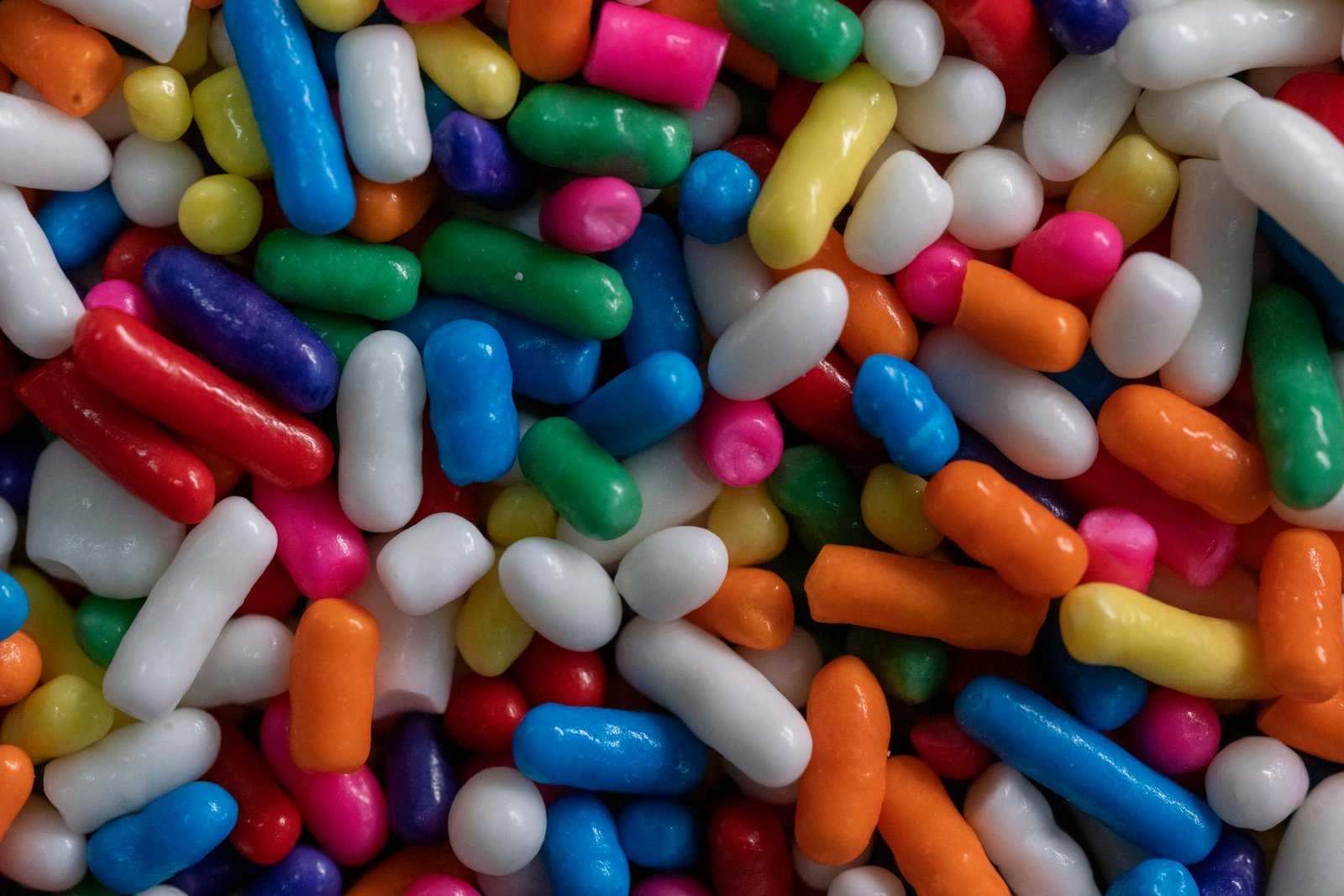
Most people eat food additives at every meal without thinking much about them — which is exactly how they’re designed to work. They don’t announce themselves. The question worth asking isn’t whether they’re present. It’s what they actually are, how they got approved, and what repeated exposure across a diet built largely on packaged food adds up to over time.
What Food Additives Actually Are
A food additive, in the regulatory sense, is any substance intentionally added to food to achieve a specific technical effect. That definition is broad by design — it covers preservatives that extend shelf life, emulsifiers that maintain texture, colorants that ensure visual consistency, sweeteners that replace or supplement sugar, and flavor compounds that deliver taste profiles independent of ingredient quality.
What distinguishes an additive from a core ingredient is function and intent. Flour, eggs, and butter in a baked good are ingredients — they form the structural and nutritional basis of the product. Calcium propionate added to that same product to inhibit mold growth is an additive — it’s there to perform a specific technical function that the core ingredients don’t provide.
The category also includes indirect additives — substances used in processing that carry over into the final product, including certain solvents and compounds that migrate from packaging materials. These don’t always appear on ingredient labels, which is a gap worth knowing about.
Additives are not inherently synthetic. Some widely used ones — citric acid, lecithin, pectin — are derived from natural sources. Others are nature-identical: synthesized to replicate a substance found in nature but produced in a laboratory. Still others are entirely synthetic. The distinction between natural and synthetic doesn’t map cleanly onto safe and unsafe, and origin alone isn’t a reliable indicator of safety profile.
How They’re Regulated in the U.S.
The FDA is responsible for evaluating food additive safety, but the framework through which it does so is more dependent on industry than most people realize — and has meaningful structural gaps.
Additives that require formal FDA approval go through a food additive petition process, in which the manufacturer submits safety data for the agency to evaluate. This applies to new additives without an established safety record.
The more significant category, in terms of sheer volume, is GRAS — Generally Recognized as Safe. A substance qualifies as GRAS if it is generally recognized among qualified scientific experts as safe under its intended conditions of use. GRAS status can be established through a long history of safe use in food, or through scientific review. The structural problem is that companies can determine GRAS status for their own ingredients through a self-assembled panel of experts and begin using the substance in food without notifying the FDA at all. A voluntary notification program exists, but participation isn’t mandatory. This means there are substances in the food supply with self-determined GRAS status that the FDA has never formally reviewed — a gap the Government Accountability Office flagged in 2010 that remains largely unresolved.
The EU operates differently. Additives must be approved by the European Food Safety Authority before use, and the approved list is maintained centrally. Several additives permitted in the U.S. are not approved in the EU — including certain artificial colorants and preservatives — reflecting a precautionary standard that the U.S. framework doesn’t apply.
The controversy around food additive regulation is not new. As far back as 1987, researchers were noting the tension between industry-driven safety assessments and independent evaluation — a tension that the GRAS self-determination framework has only deepened over time.
The Main Categories Worth Knowing
Preservatives prevent spoilage by inhibiting microbial growth, oxidation, or both. Common preservatives include sodium benzoate, potassium sorbate, calcium propionate, BHA, and BHT. BHA and BHT — synthetic antioxidants used to prevent fat oxidation — have been more actively scrutinized. The National Toxicology Program has listed BHA as reasonably anticipated to be a human carcinogen based on animal studies. Research has also linked certain preservatives to adverse reactions in sensitive individuals, including urticaria, asthma exacerbation, and gastrointestinal symptoms. Lloyd and Drake identified as far back as 1975 that widely used food preservatives posed health questions that the regulatory framework at the time was not adequately equipped to answer — a concern that has carried forward into more recent research. Eigenmann and Haenggeli further documented associations between certain preservatives and colorants and hyperactivity and allergic responses in children, findings that contributed to the EU’s decision to require warning labels on affected products.
Emulsifiers and stabilizers maintain texture and prevent separation. Lecithin is one of the most widely used and broadly considered low concern. Others have raised more active questions. Research published in Molecules in 2023 found that certain emulsifiers and food additives more broadly can meaningfully affect the abundance and composition of gut microbiota — disrupting microbial diversity and potentially contributing to gut barrier dysfunction. Polysorbate 80 and carboxymethylcellulose have been specifically studied in this context, with findings suggesting that regular consumption at levels consistent with typical dietary exposure may affect gut health over time.
Colorants maintain or enhance the visual appearance of food. Natural colorants — derived from beets, turmeric, and annatto — are required to be listed by their common name. Artificial colorants — FD&C Red 40, Yellow 5, Yellow 6, and others — are petroleum-derived synthetic dyes. Research by Eigenmann and Haenggeli documented associations between artificial colorants and preservatives and hyperactivity and hypersensitivity responses, particularly in children — findings that informed the EU’s decision to require warning labels on products containing certain artificial dyes. The FDA reviewed the evidence and declined to act at the federal level, though California has since passed legislation requiring the same warning for products sold in the state.
Sweeteners fall into nutritive and non-nutritive categories. Added sugars — beyond their caloric contribution — have been linked to inflammatory responses in the body, a topic covered in more depth in a dedicated article coming to this category. Non-nutritive sweeteners, including aspartame, sucralose, and saccharin as well as naturally derived options like stevia, carry their own research profile. Research by Moriconi et al. found that low-calorie and non-calorie sweeteners can produce neuroendocrine and metabolic effects — influencing hormonal responses and metabolic function in ways that go beyond their caloric content. This is research worth looking into independently.
Flavor compounds appear on ingredient lists as “natural flavor” or “artificial flavor.” Neither designation tells you what specific compounds are present, as flavor formulations are protected as trade secrets. A product can contain a complex blend of compounds under either designation without any requirement for individual component disclosure.
What the Research Is Telling Us
Adverse reactions to food additives — ranging from hypersensitivity responses to more systemic effects — are more common than the regulatory framework’s approval of these substances might suggest. Research by Wilson and Bahna and by Randhawa and Bahna documents a range of reactions across additive categories, noting that sensitivity varies significantly by individual and that reactions are frequently underreported and underdiagnosed. The cumulative picture across studies suggests that additive safety assessments based on individual compounds at defined exposure levels may not fully account for how people actually encounter these substances — across multiple products, daily, over years.
The gut microbiome research adds another dimension. The 2023 Zhou et al. study found that food additives — particularly emulsifiers, artificial sweeteners, and certain preservatives — can alter the composition and diversity of gut microbiota in ways that may have downstream effects on immune function and metabolic health. The findings reinforce the case for limiting additive exposure where possible.
The older research on additives and cancer, while limited by the methodological standards of its time, identified carcinogenic potential in several compounds that were in wide use — some of which have since been restricted, and some of which remain in use today. The history of additive regulation is in part a history of approvals that were later revisited as evidence accumulated, which is relevant context for evaluating the confidence we should place in current approvals.
How to Identify Them on a Label
Additives are required to appear in the ingredient list but their names aren’t always immediately recognizable. A few practical patterns help. Additives typically appear toward the end of an ingredient list, since they’re present in smaller quantities than core ingredients. Chemical names, function descriptors in parentheses — “sodium benzoate (preservative),” “carrageenan (stabilizer)” — and unfamiliar multi-syllable terms are reliable signals. The EWG Food Scores database is a useful reference for looking up specific additives and reviewing available safety data.
The more instructive signal is often the length and complexity of the ingredient list itself. A long list of additives across multiple functional categories — preservatives, emulsifiers, colorants, and flavor compounds all present in the same product — is a reliable indicator of how far that product has moved from whole food sources.
The Most Practical Response
Understanding additives category by category is useful, but the most efficient way to reduce additive exposure isn’t tracking individual compounds across every product you eat. It’s reducing the overall proportion of heavily processed food in your diet.
Ultra-processed foods — Group 4 in the NOVA classification covered in What Processed Really Means — and Why It Matters rely structurally on additives in ways that less processed foods don’t. Emulsifiers, stabilizers, colorants, and flavor compounds aren’t incidental to ultra-processed formulations — they’re what makes the category function. Shifting toward whole and minimally processed foods as a baseline reduces additive exposure across the board, without requiring ingredient-by-ingredient evaluation of every product.
That doesn’t mean every packaged food with additives is worth avoiding, or that whole food eating has to be all-or-nothing. It means that whole foods are the most reliable default — and that when packaged foods are part of the picture, the ingredient list gives you the most direct read on what you’re actually buying.
Building the Picture
Food additives are a normal feature of most packaged food, and they’ve been part of the food supply long enough that their presence feels unremarkable. What the research shows is that unremarkable doesn’t mean without effect — particularly at the cumulative exposure levels typical of a diet built substantially around packaged and processed products.
Knowing what additive categories exist, how the regulatory framework does and doesn’t protect consumers, and what the research suggests puts you in a better position to make informed choices — starting with the ingredient list, and building from here. The references used in this article are a starting point — we encourage you to read further and draw your own conclusions.
Ready to keep going? Browse our Mindful Eating articles to build a clearer picture of what’s in your food and how to evaluate it.


Leave a Reply