
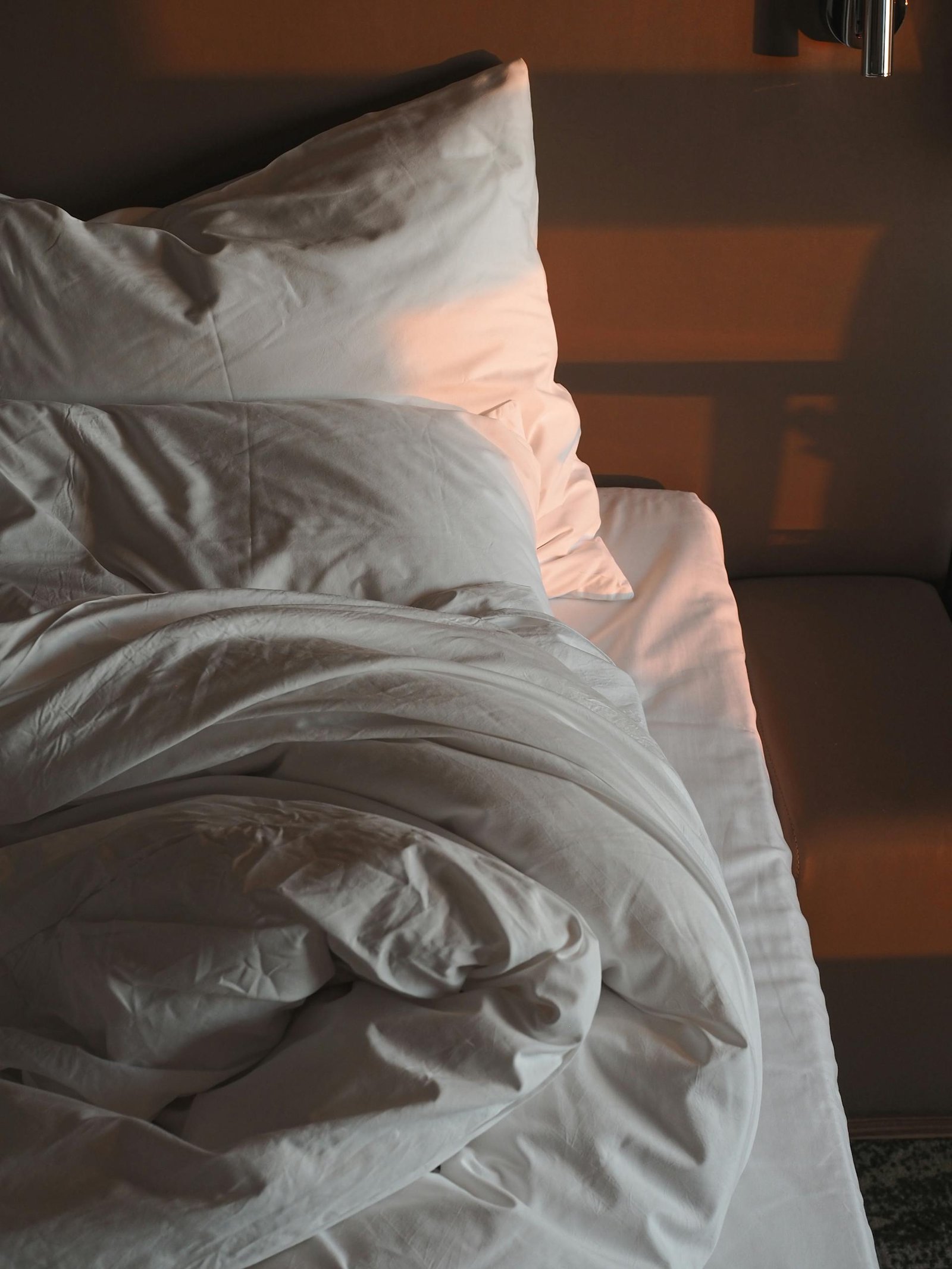
Most people think about the bedroom as a sanctuary — a space for rest and recovery. What gets less attention is that the bedroom is also where most people spend 7-9 hours a night in sustained, close contact with the materials, air, and devices surrounding them. That duration makes it the highest-leverage room in the home to evaluate from an exposure standpoint.
This article is the second in the Hidden Toxin Exposure series — a room-by-room guide to the overlooked exposure sources in the home. Each installment covers one room in depth, building on the foundational overview in Hidden Toxin Exposure in the Home: What Most People Overlook. The bedroom comes first because the duration and intimacy of exposure here — skin contact with bedding for hours, breathing bedroom air through the night, sleeping near devices — means that what’s in this room has more cumulative impact than almost any other.
Your Mattress
The mattress is the most significant material exposure in the bedroom, and also one of the least examined at the point of purchase. Most people spend more time evaluating firmness and price than what the mattress is actually made from — which is where the more relevant information sits.
Conventional mattress construction typically involves polyurethane foam as the primary fill material. Polyurethane is petroleum-derived and can off-gas volatile organic compounds — including isocyanates — most intensively when new, with emissions tapering over time. A new mattress in an enclosed bedroom with limited ventilation is one of the more significant off-gassing events in a typical home, which is worth factoring into both purchasing decisions and room ventilation habits.
Flame barriers are a specific consideration for mattresses that doesn’t come up in most purchasing conversations. Federal flammability standards require that mattresses meet defined open-flame resistance criteria. Most conventional mattresses meet this standard through a chemical flame barrier — fiberglass is one of the most commonly used materials, applied as a layer within the mattress cover. When fiberglass is used as a flame barrier and the mattress cover is removed or damaged, fiberglass particles can become airborne or embed in surrounding fabrics and surfaces. Manufacturers are not required to disclose what flame barrier material is used, which means asking directly is the only way to know. Alternative — wool-based barriers — meet the same flammability standard without the same risks.
What to look for: Natural latex as an alternative to polyurethane foam, wool or thistle as flame barrier materials, and certifications that verify the formulation. GOLS — the Global Organic Latex Standard — confirms that latex meets organic sourcing and processing standards. GOTS certification covers organic fiber components including covers and batting. GREENGUARD Gold evaluates finished products for low chemical emissions and is one of the more directly relevant certifications for mattress off-gassing specifically. As covered in How to Evaluate Furniture Materials Before You Buy, asking manufacturers directly about foam type, flame barrier material, and relevant certifications produces more useful information than product listings alone.
Bedding and Textiles
Bedding — sheets, pillowcases, duvet covers, duvet inserts, and pillows — maintains direct skin contact for the full duration of sleep. What the fabric is made from and how it’s been treated are worth knowing for the same reason personal care product ingredients are worth knowing: sustained skin contact over hours is a different exposure dynamic than brief or intermittent contact.
Conventional bedding fabrics are most commonly cotton — which varies significantly in quality and treatment depending on whether it’s conventionally or organically grown — or synthetic blends including polyester and microfiber. Conventionally grown cotton is one of the more pesticide-intensive crops globally, and residues from agricultural inputs can persist in finished fabric. Synthetic fabrics are petroleum-derived and can off-gas during use, particularly when new.
Pillows and duvet inserts introduce a fill material layer that’s worth evaluating separately from the fabric cover. Conventional pillows and duvet inserts are most commonly filled with polyester fiberfill — petroleum-derived and subject to the same off-gassing considerations as other synthetic materials. Down and feather fills are natural alternatives but vary in how they’re processed and treated — some undergo chemical cleaning and treatment during processing that introduces compounds into the finished product. Wool and natural latex fills are the more transparent alternatives — wool in particular is naturally resistant to dust mites and mold, which makes it a practical as well as low-toxin choice for pillow and duvet fill. When evaluating fill materials, looking for GOTS certification on wool or cotton fills and GOLS certification on latex confirms that the fill meets organic sourcing and processing standards.
Fabric treatments add another layer. Wrinkle-resistant and permanent press finishes are typically achieved through formaldehyde-based treatments that remain in the fabric after processing. Stain-resistant treatments have historically used PFAS compounds. Antimicrobial treatments applied to some bedding products use biocidal compounds that stay active in the fabric by design. None of these treatments are required to be disclosed on bedding labels in the U.S.
GOTS certification is the most rigorous reference point for organic fiber bedding — covering fiber sourcing, processing, and finishing across the full supply chain. OEKO-TEX Standard 100 evaluates finished textile products for harmful substances including pesticide residues, formaldehyde, and certain dyes, and applies to every component of the finished product. As covered in What Third-Party Certifications Actually Tell You, the two certifications answer different questions and are often worth looking for in combination.
Air Quality
The air in the bedroom accumulates compounds from multiple sources simultaneously — furniture, flooring, paint, and textiles all contribute to the indoor air environment, and because bedrooms are often smaller and less ventilated than main living areas, those contributions concentrate more readily.
Off-gassing from furniture and flooring is covered in depth in Volatile Organic Compounds at Home Guide. In the bedroom context specifically, the most relevant sources are the mattress, bed frame, dresser, and flooring — all of which can contribute VOCs to bedroom air, most intensively when new. Allowing new furniture and flooring to air out before bringing it into an enclosed bedroom, and maximizing ventilation in the room during the first weeks after installation or purchase, reduces the initial off-gassing load meaningfully.
Paint and finishes on bedroom walls and furniture surfaces are another consistent source. Conventional oil-based paints and stains off-gas VOCs for months after application. Low-VOC and zero-VOC formulations reduce this significantly and are worth prioritizing for bedroom surfaces, given the hours spent breathing that air.
Air purifiers are one of the most practical investments for bedroom air quality. A HEPA and activated carbon unit running in the bedroom addresses both particulates and gaseous compounds — capturing VOCs, dust, allergens, and mold spores from the air during the hours when you’re most consistently present in the room. Given that the bedroom is typically where the most sustained indoor air exposure occurs, it’s the highest-priority room for air purification in most homes.
EMF During Sleep
The bedroom is where most people have their highest sustained EMF exposure — not because bedroom devices are uniquely powerful, but because sleep represents the longest uninterrupted period of proximity to whatever devices are present in the room.
WiFi routers emit radiofrequency electromagnetic fields continuously when active. A router in or adjacent to the bedroom — or a strong signal passing through bedroom walls from a nearby room — contributes to overnight EMF exposure in a way that a WiFi timer addresses directly. As covered in Hidden Toxin Exposure in the Home: What Most People Overlook, a WiFi timer that powers down the router’s wireless signal during sleep hours is a straightforward way to reduce overnight exposure without eliminating WiFi access during waking hours.
Phone placement during sleep is one of the more actionable adjustments available without any product purchase. Phones emit radiofrequency radiation most actively when transmitting — during calls, when searching for signal, and when syncing data. Keeping the phone across the room rather than on a nightstand, switching to airplane mode during sleep, or using a separate alarm clock to remove the phone from the bedroom entirely are low-friction steps that meaningfully reduce the proximity and duration of overnight phone exposure.
Other bedroom devices — smart speakers, tablets, baby monitors, and televisions — contribute to the bedroom EMF environment in ways that are worth inventorying. A dedicated article on EMF in the home is in the books and goes deeper on the research and the specific steps worth taking across device categories.
Where to Start
The bedroom has enough overlapping exposure categories that knowing where to begin is worth addressing directly.
The mattress is the highest priority. It’s the largest surface area in sustained skin contact, present for the longest duration, and one of the harder purchases to reverse once made. Evaluating mattress materials before the next purchase — or at minimum understanding what your current mattress contains — is the most impactful single step available in the bedroom.
Bedding is the most actionable immediate change. Unlike a mattress, bedding can be replaced incrementally — starting with pillowcases, then sheets, then duvet covers — without a significant upfront investment. Prioritizing GOTS or OEKO-TEX certified options in natural fibers and switching to a fragrance-free, dye-free laundry detergent addresses both the fabric and the laundry product layer simultaneously.
Air quality and EMF are low-cost, high-impact adjustments. A WiFi timer and phone placement change cost nothing. An air purifier is an investment, but one that addresses multiple exposure categories — VOCs, particulates, mold spores — in a single step.
Progress through these in the order that makes most sense for your current situation. The goal isn’t to address everything at once — it’s to build a clearer picture of what’s in the room and work through it at a pace that’s sustainable.
The Room Worth Starting With
The bedroom is the highest-duration exposure environment in most homes. What’s in it — the mattress, the bedding, the air, the devices — contributes to what the body is in contact with and breathing for roughly a third of every day. That makes it the most practical starting point for building a lower-toxin home, and the room where deliberate material and product choices have the most cumulative impact over time.
The bedroom is the second stop in our Hidden Toxin Exposure series — room-by-room guides to the overlooked exposure sources in your home. Browse our Conscious Home articles to keep building from here, and stay tuned for our non-toxic bedroom product recommendations article, coming soon.


Leave a Reply