
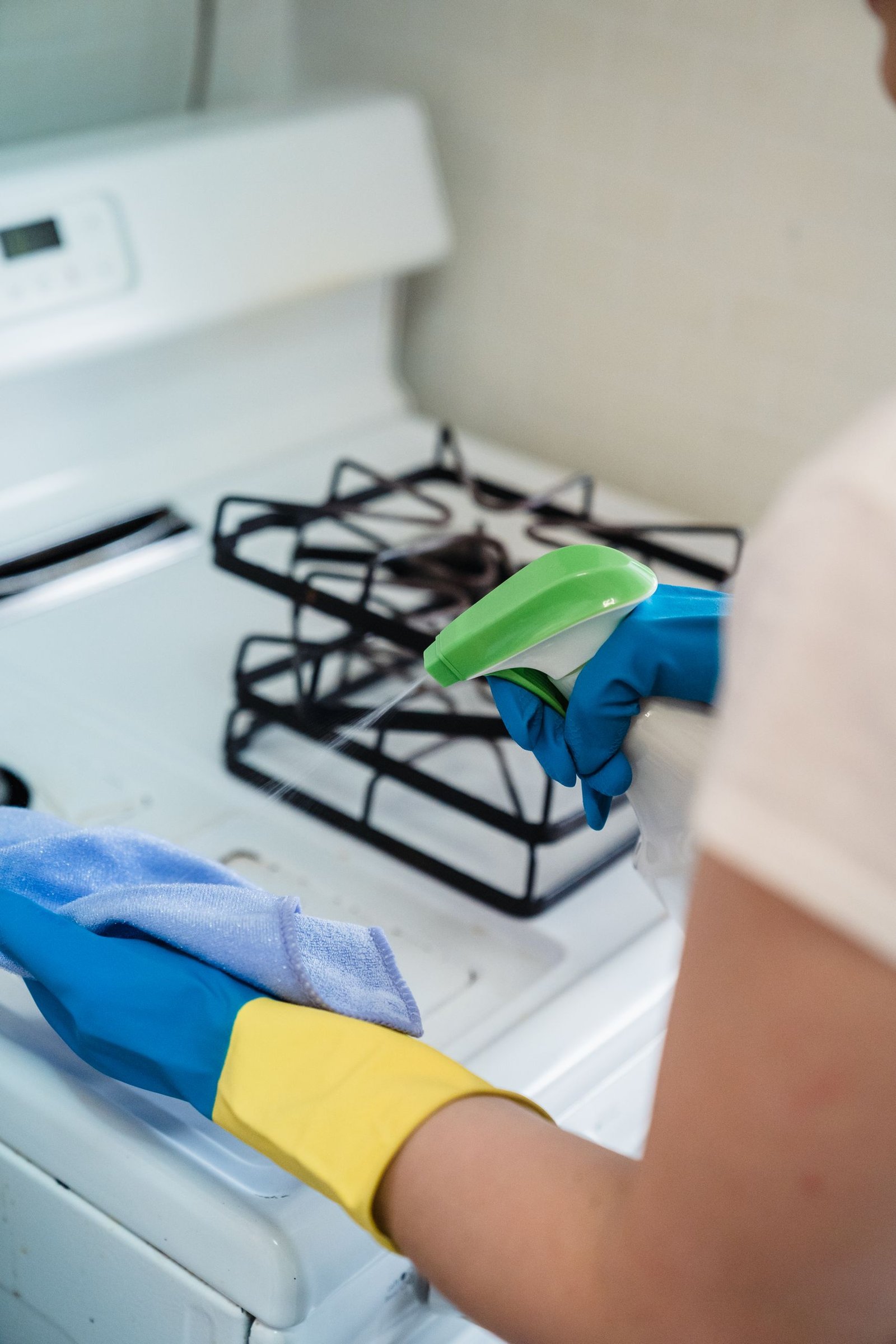
Cleaning products are designed to do a specific job — cutting through grease, disinfecting surfaces, removing stains, eliminating odors. Doing that job effectively often requires chemically active ingredients that are strong enough to break down what soap and water can’t. That’s the point. What gets less attention is what happens after the cleaning is done.
The scent fades. The surface dries. The product gets put away. But the compounds released during and after use don’t simply disappear — they volatilize into the air, linger in enclosed spaces, and contribute to indoor air quality in ways that aren’t visible and aren’t communicated anywhere on the label. Research has found that cleaning products are one of the more significant sources of indoor VOC exposure in the home — and that the label on most of them tells you very little about what you’re actually releasing into the air you’re breathing.
That label gap is what this article is about — what cleaning product labels are required to tell you, what they’re allowed to leave out, and where to find the information that isn’t there.
Why Cleaning Product Labels Are Different
Cleaning products sold in the U.S. occupy a regulatory space with fewer disclosure requirements than food, personal care products, or pharmaceuticals. The primary federal law governing household cleaning products is the Federal Hazardous Substances Act, which requires that products containing hazardous substances carry specific warning language and safety information. It does not require a full ingredient list.
The Consumer Product Safety Commission oversees cleaning product safety under this framework, but its mandate is focused on acute hazard communication rather than comprehensive ingredient disclosure. As Spök, Arvanitakis, and McClung documented in their review of cleaning product regulations across the U.S., EU, and Canada, the U.S. framework lags behind the EU’s approach — which requires more extensive ingredient disclosure and places stricter limits on certain compounds — reflecting a fundamental difference in how the two regulatory systems approach consumer product transparency.
What this means in practice is that a cleaning product manufacturer can formulate a product with dozens of individual ingredients and be legally required to disclose only a fraction of them on the label. Sawalha’s research on storage and utilization patterns of cleaning products in the home noted that consumers are frequently unaware of what their cleaning products contain — a gap the current regulatory framework does nothing to close.
What Has to Be on the Label
What cleaning product labels are required to include is worth knowing specifically — because it’s more useful than it’s typically treated as.
Signal words appear on the front of most cleaning products and indicate the level of acute hazard the product presents. “Danger” is the highest hazard level — indicating that the product can cause severe injury or death through ingestion, inhalation, or skin contact. “Warning” indicates a moderate hazard level. “Caution” indicates a lower but still present hazard. A product with no signal word has been assessed as not meeting the threshold for any of these categories under current standards — though that doesn’t mean it contains no ingredients worth knowing about.
First aid instructions tell you what to do in case of accidental exposure — and they’re worth reading before you need them rather than after. The specific instructions — whether to rinse with water, induce vomiting, or call poison control — reflect the nature of the hazardous ingredients in the product, which gives you indirect information about what those ingredients are even when they’re not listed by name.
Active disinfectant ingredients are required to be disclosed on products registered as disinfectants with the EPA. When a product carries an EPA registration number — which appears on the label — the active disinfecting ingredients are listed. This is one of the few categories where cleaning product ingredient disclosure is required beyond general hazard communication.
Directions for use are required and are worth following specifically — not only for safety but because they reflect how the product was tested. Using a disinfectant at a concentration or contact time other than what’s specified affects both safety and efficacy in ways the label directions are designed to prevent.
What Doesn’t Have to Be on the Label
The gaps in cleaning product label disclosure are more significant than the required disclosures.
Inactive or inert ingredients — a category that in cleaning products can include surfactants, solvents, fragrance compounds, preservatives, and stabilizers — are not required to be individually listed on the label. A product can list “surfactants,” “fragrance,” or simply “other ingredients” as a collective entry without specifying what those categories contain. Wang et al.’s critical review of cleaning product ingredients in all-purpose cleaners, dish care, and laundry products documented a wide range of compounds present in these products that aren’t required to appear on their labels — including compounds associated with respiratory effects, skin sensitization, and endocrine disruption.
Fragrance in cleaning products follows the same trade secret protection as fragrance in personal care products — a single “fragrance” entry can represent dozens of individual compounds whose full composition isn’t disclosed. As covered in What “Fragrance” on a Label Actually Means, this is one of the more significant label gaps across consumer product categories. Research by Temkin et al. found that both conventional and products marketed as “green” emit VOCs — including fragrance-derived compounds — into indoor air during and after use, with some green products emitting VOC levels comparable to conventional ones. The “green” or “natural” label on a cleaning product doesn’t reliably indicate a lower fragrance compound burden.
Concentrations of listed ingredients aren’t required to be disclosed. Knowing that a product contains a specific compound tells you less without knowing at what level — though the signal word system provides a rough proxy for overall hazard level.
Byproducts and contaminants that form during manufacturing or storage aren’t listed because they aren’t intentional ingredients — but Singer et al.’s research on emissions from cleaning products documented that glycol ethers and terpenoids released from cleaning products contribute to indoor air contamination in ways that don’t appear on any label.
Voluntary Disclosure Programs and What They Tell You
Several programs fill the gap that mandatory disclosure leaves open — and knowing about them makes navigating cleaning products significantly more practical.
The EPA Safer Choice program certifies cleaning products that meet defined standards for ingredient safety, packaging, and performance. Products carrying the Safer Choice label have had every ingredient evaluated by the EPA against safety criteria — it’s one of the more rigorous voluntary standards available for cleaning products in the U.S. The EPA maintains a searchable database of Safer Choice certified products that allows consumers to verify certification and look up specific products before purchasing.
The EWG Cleaning Product Guide rates cleaning products and their ingredients on a hazard scale from A to F based on available safety data. It covers thousands of products and allows ingredient-level lookup — making it a practical reference for evaluating specific products or compounds encountered on a label.
Some brands voluntarily disclose full ingredient lists on their packaging or websites beyond what’s legally required. This voluntary disclosure is a transparency signal worth noting — brands that choose to disclose their full formulation are providing information they have no regulatory obligation to share.
What to Look for and What to Avoid
The most consistently documented concerning ingredients in conventional cleaning products fall into a few categories worth knowing specifically.
Quaternary ammonium compounds — commonly called quats — are the active disinfecting ingredients in most antibacterial sprays, wipes, and surface cleaners. Arnold et al.’s 2023 comprehensive review classified quats as a chemical class of emerging concern, documenting associations with respiratory sensitization, skin irritation, reproductive effects, and potential contributions to antimicrobial resistance. They appear on ingredient lists under names including benzalkonium chloride, didecyl dimethyl ammonium chloride, and alkyl dimethyl benzyl ammonium chloride. Pacheco Da Silva et al.’s 2025 study on long-term disinfectant exposure found associations between regular cleaning product use and asthma development — with disinfectant-containing products showing the strongest associations.
Synthetic fragrance is present in most conventional cleaning products and releases VOCs into indoor air during and after use. As covered in Volatile Organic Compounds at Home: A Plain-Language Guide, fragrance compounds from cleaning products contribute to indoor VOC levels that persist in enclosed spaces — particularly in bathrooms and kitchens with limited ventilation. Dumas and Le Moual’s research on household cleaning products and lung health documented that regular cleaning product use — particularly spray products used in enclosed spaces — is associated with measurable effects on respiratory function over time.
Chlorine bleach — sodium hypochlorite — releases chlorine gas in enclosed spaces during use and produces toxic chloramine gas when it comes into contact with ammonia — a compound present in many glass and multi-surface cleaners. As covered in Hidden Toxin Exposures in the Bathroom, these two products should never be used together or in sequence in an enclosed space without thorough ventilation between applications. Winslow and Gerstner’s research on chlorinated compounds and Kore and Kiesche-Nesselrodt’s foundational toxicology review of household cleaning products both documented the respiratory and systemic health implications of chlorinated cleaning compound exposure.
Glycol ethers — solvents used in many all-purpose cleaners, degreasers, and glass cleaners — are absorbed through the skin and respiratory tract and have been associated with reproductive toxicity in research settings. Singer et al. documented their emission from conventional cleaning products into indoor air during use. They appear on ingredient lists under names including 2-butoxyethanol, propylene glycol n-butyl ether, and ethylene glycol monobutyl ether.
Enzymes — used in laundry detergents and some all-purpose cleaners as biological cleaning agents — are generally considered lower concern than the categories above, but Basketter et al.’s review of enzyme toxicology in cleaning products noted that certain enzymes can be respiratory sensitizers with repeated inhalation exposure in occupational settings. For home use the exposure level is lower, but it’s worth noting as an ingredient category that isn’t uniformly benign.
How Certifications Apply
EPA Safer Choice certification is the most directly relevant standard for cleaning products — it covers the full ingredient profile of a product rather than a single compound or category, and it’s independently administered by the EPA rather than by the brand or retailer. As covered in What Third-Party Certifications Actually Tell You, certifications work best when you understand what specific criteria they verify. For cleaning products, Safer Choice is the most comprehensive available standard — and its presence on a product means every ingredient has been evaluated against defined safety criteria, including fragrance compounds and surfactants that aren’t required to be disclosed on the label.
For cleaning products without Safer Choice certification, the EWG Cleaning Product Guide rating provides a useful secondary reference — particularly for evaluating specific ingredients or compounds encountered on a label that aren’t immediately recognizable.
Reading What’s There — and Looking for What Isn’t
Cleaning product labels are built to communicate hazard, not composition. The signal word tells you how dangerous the product is to handle. The first aid instructions tell you what happens if it goes wrong. The active disinfectant ingredients, when listed, tell you what’s doing the disinfecting. Everything else — the surfactants, the solvents, the fragrance compounds, the stabilizers — exists in the label’s gaps.
Knowing what voluntary disclosure programs exist, which certifications cover the ingredients that labels don’t, and which ingredient categories are most worth investigating when you can find them — on brand websites, in EWG’s database, or through EPA Safer Choice listings — gives you a more complete picture of what’s in your cleaning products than the label alone provides.
The references used in this article are a starting point — we encourage you to read further and draw your own conclusions.
The framework is one piece of the picture. Browse our Conscious Home articles to build on what you know — and make more informed choices about what you bring into your space.

Leave a Reply