
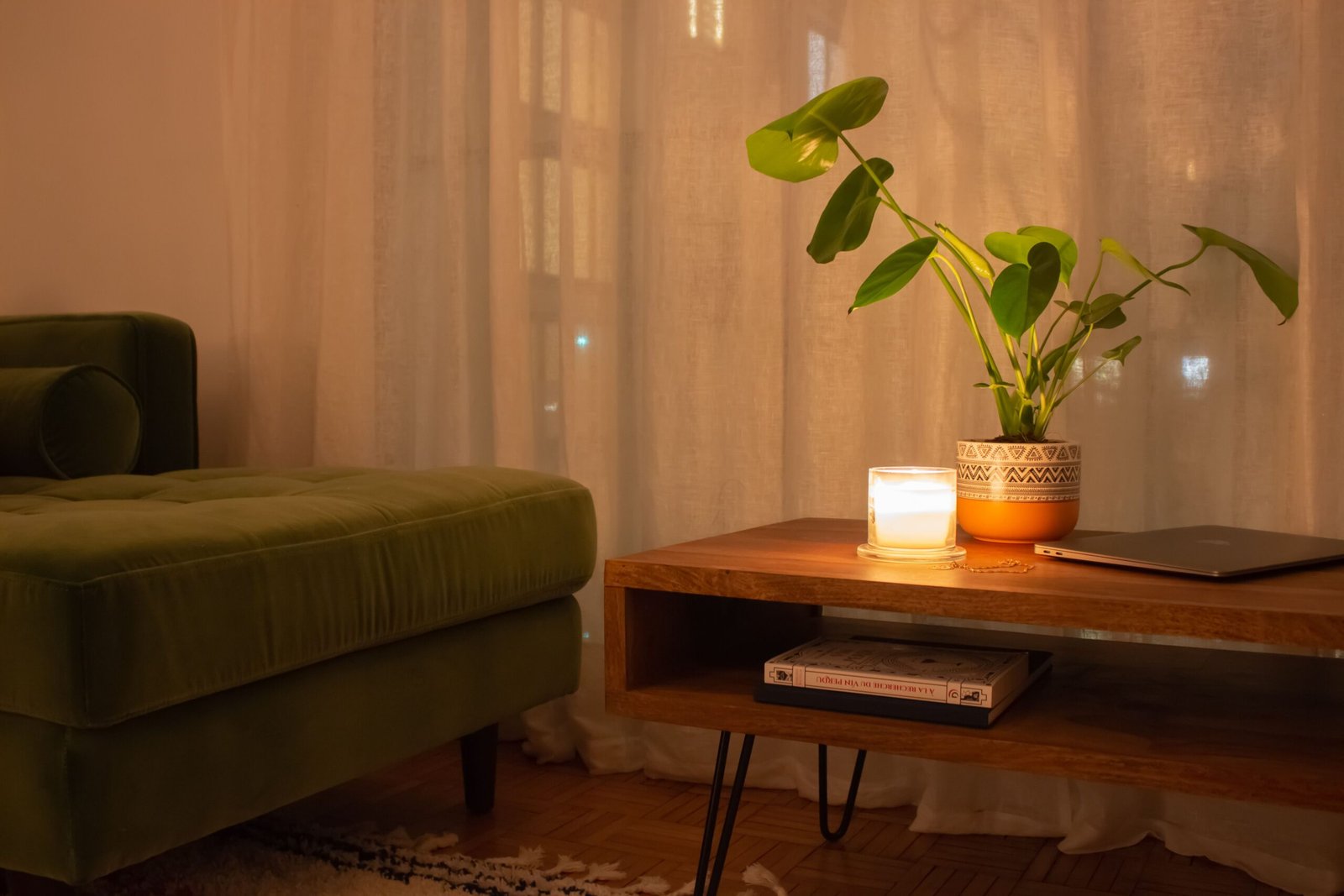
The living room is where most waking hours at home are spent — the room for unwinding after work, watching television, entertaining guests, and spending time with family. The Hidden Toxin Exposure Series has saved some of its less examined territory for last. The bedroom introduced mattress materials, bedding, and EMF during sleep. The kitchen covered cookware, food storage, and water quality. The bathroom addressed personal care product load, shower exposure, and cleaning products in an enclosed space. The laundry room covered what stays on fabric after washing.
The living room builds on all of it. Furniture materials, VOCs, synthetic fragrance, and EMF have been introduced across earlier installments — this article focuses on what hasn’t been covered in depth yet: flooring, carpet, coffee tables, side tables, lighting, candles, air fresheners, artificial plants, and the cumulative exposure picture of the room where the most time is spent awake.
This is the fifth installment in the Hidden Toxin Exposure Series.
Flooring
Flooring covers more surface area than almost any other material in the living room — and in many homes, that surface area is covered with vinyl or carpet, two of the more chemically significant flooring options available.
Vinyl flooring — including luxury vinyl plank, vinyl tile, and sheet vinyl — is one of the most widely installed flooring types in residential homes because of its durability, water resistance, and cost. It’s also one of the more significant VOC sources in a home environment. Vinyl flooring is made from PVC — polyvinyl chloride — which requires phthalate plasticizers to achieve the flexibility that makes it practical for flooring applications. These phthalates off-gas from the flooring surface over time, contributing to indoor VOC levels throughout the room. As covered in Volatile Organic Compounds at Home: A Plain-Language Guide, VOC off-gassing is most intensive when materials are new and in warm conditions — a sunny living room with new vinyl flooring is a more active off-gassing environment than the same room in cooler conditions with older flooring.
The adhesives used to install vinyl flooring add another off-gassing source — conventional flooring adhesives contain solvents and compounds that release VOCs during and after installation, with emissions tapering over time but not disappearing. CARB2 compliance — the California Air Resources Board’s standard for formaldehyde emissions — applies to composite wood products rather than vinyl, but looking for flooring installed with low-VOC adhesives and choosing products that carry GREENGUARD Gold certification for emissions addresses the most significant off-gassing concerns at the point of purchase.
Carpet presents a different but equally significant exposure profile. Carpet itself — particularly synthetic carpet made from nylon, polyester, or olefin — can off-gas VOCs from the fiber, the backing, and the adhesives used during installation. But carpet’s more persistent contribution to the living room exposure environment is as a chemical reservoir. Carpet fibers trap and accumulate dust, pet dander, pesticide residues tracked in from outside, microplastic fibers shed from synthetic textiles, and particles from flame retardants shed by upholstered furniture over time. That accumulated material is disturbed and redistributed into the room’s air during walking, vacuuming, and everyday activity — making carpet a sustained source of airborne exposure from compounds that originated elsewhere in the home and environment.
Regular vacuuming with a HEPA-filtered vacuum — which captures fine particles rather than recirculating them — and limiting outdoor shoes in carpeted areas reduces the rate of chemical accumulation without requiring flooring replacement. Hard flooring alternatives — solid hardwood, cork, or stone — don’t accumulate chemicals the way carpet does and are easier to clean thoroughly.
Coffee Tables and Side Tables
Coffee tables and side tables are among the most commonly composite-wood-constructed pieces of furniture in a living room — and among the least examined from a material standpoint, because they’re functional rather than comfort-oriented and their material profile doesn’t typically factor into purchasing decisions.
Most flat-pack and mid-range coffee tables and side tables are built from particleboard or MDF — medium-density fiberboard — both of which use urea-formaldehyde or similar adhesive resins that off-gas formaldehyde over time. As covered in How to Evaluate Furniture Materials Before You Buy, composite wood products are most significant during the period immediately after purchase and in warmer environments where off-gassing accelerates.
Surface finishes on coffee tables — lacquers, varnishes, and UV-cured coatings — add another off-gassing layer. A coffee table with a high-gloss finish in a warm, sunny living room off-gasses more actively than one with a natural oil finish in a cooler, shaded space.
What to look for: solid wood construction where possible — even in smaller accent pieces, solid wood eliminates the composite wood off-gassing concern. CARB2 compliant composite wood products are the most direct filter when solid wood isn’t available or practical. Water-based or low-VOC finishes reduce the surface coating off-gassing contribution. GREENGUARD Gold certification on furniture covers the full emissions profile of a finished piece and is worth looking for specifically for pieces that will be in a frequently occupied space.
Lighting
Lighting in the living room affects more than visibility — and this is an angle that has been introduced in the Hidden Exposures overview but is worth expanding on here, because the living room is where evening lighting choices have the most direct impact on sleep and hormonal health.
As introduced in Hidden Toxin Exposures in the Home: What Most People Overlook, conventional LED bulbs emit significant amounts of blue light — the wavelength that signals daytime to the brain. Exposure to blue light in the evening hours suppresses melatonin production — the hormone that regulates sleep onset — and disrupts the circadian rhythm, the body’s natural 24-hour cycle that governs sleep, metabolism, immune function, and hormonal patterns.
The living room is where most people spend their evening hours — watching television, reading, spending time with family — and where overhead lighting choices therefore have the most direct influence on the body’s preparation for sleep. Overhead LED lighting at full brightness in the hours before bed is one of the more consistent sources of evening blue light exposure in most homes.
Switching to warm-toned bulbs with a color temperature below 3000K reduces blue light emission meaningfully. Incandescent bulbs emit a warmer, redder light spectrum with significantly less blue light than LEDs and are a straightforward alternative for living room fixtures used in the evening. Dimming lights in the hours before bed reduces both blue light exposure and overall light intensity — both of which affect melatonin suppression. Smart bulbs that shift to warmer tones automatically in the evening are a practical option for those who prefer to keep LED lighting.
Televisions and screens add a separate blue light source that operates independently of overhead lighting — blue light filtering settings on devices and television settings that reduce color temperature in the evening are complementary steps to changing overhead lighting.
Candles and Diffusers
The living room is where candles and diffusers are most commonly used — for atmosphere, for scent, and for the sense of calm that comes with them. What they contribute to indoor air quality in an enclosed space is worth knowing before they become a daily habit.
Paraffin candles — the most widely sold type — are petroleum-derived and release compounds including benzene, toluene, and particulate matter when burned. The combustion process converts the paraffin and fragrance compounds in the candle into airborne particles and gases that accumulate in indoor air, particularly in rooms with limited ventilation. The fragrance compounds in scented candles add another layer — as covered in What “Fragrance” on a Label Actually Means, synthetic fragrance blends contain undisclosed compounds that behave differently when combusted than they do at room temperature. Heat from burning can alter the chemical composition of fragrance compounds and generate byproducts that weren’t present in the original formula.
Unscented beeswax candles are the more transparent alternative — beeswax burns without the same petrochemical byproducts and emits a warmer, more natural light. For those who use candles primarily for scent, candle warmers are worth considering — they release fragrance through gentle heat without combustion, eliminating the particulate and combustion byproduct concerns entirely.
Essential oil diffusers are often assumed to be a clean alternative to synthetic fragrance candles — and cold-air diffusers that nebulize or ultrasonically disperse essential oils without heat are generally more transparent than combustion-based options. What’s worth knowing is that essential oil compounds, while naturally derived, are still volatile organic compounds that contribute to indoor VOC levels. In a small, enclosed living room with limited ventilation, a diffuser running continuously contributes to the room’s VOC load — not at the level of paraffin candle combustion, but not neutrally either. Diffusing intermittently rather than continuously and ensuring ventilation during use addresses the most relevant concern.
Air Fresheners and Plug-Ins
Air fresheners and plug-in diffusers are among the most direct sources of synthetic fragrance compound exposure in the living room — and among the most consistently used, since their function is continuous rather than occasional.
Plug-in air fresheners work by heating a synthetic fragrance compound to release it continuously into the room air. The heating element volatilizes the fragrance blend — driving it into the air at a constant rate throughout the day. The same fragrance compound concerns that apply to any synthetic fragrance product apply here — the specific compounds within the blend aren’t disclosed, and continuous low-level inhalation exposure in an occupied room represents a different exposure profile than a brief product application.
Spray air fresheners release a burst of fragrance and propellant into the air — adding aerosol propellants to the fragrance compound exposure. Both types mask odor rather than addressing its source, which means the underlying air quality concern remains while a synthetic fragrance layer is added on top of it.
Addressing odor at its source — ventilation, identifying and resolving moisture or mold issues, removing the cause rather than covering it — is the more direct approach. Where scent is the primary goal rather than odor masking, the candle and diffuser alternatives covered above are more transparent options.
Artificial Plants
Artificial plants are a common living room decorative choice — and one that contributes to the room’s exposure environment in ways that aren’t immediately obvious.
Most artificial plants are made from PVC — the same material used in vinyl flooring — which requires phthalate plasticizers to achieve the flexibility that makes artificial leaves and stems look realistic. These phthalates off-gas from the plastic over time, contributing to indoor VOC levels. In warm environments or near heat sources — a sunny windowsill, a room with a heat vent nearby — off-gassing accelerates. Some artificial plants, particularly older ones or imported pieces from manufacturers with less stringent production standards, have been found to contain lead in the stabilizers used during PVC manufacturing — a concern most consumers have never been given reason to examine.
Artificial plants are also significant dust collectors. Synthetic leaves accumulate dust continuously — and household dust carries compounds from multiple sources including pesticide residues tracked in from outside, flame retardant particles shed from furniture, and microplastic fibers from synthetic textiles. A display of artificial plants that’s rarely cleaned becomes a concentrated reservoir of accumulated compounds that are redistributed into the room’s air during dusting, touching, or air movement.
For those who want botanical displays without the PVC and dust concerns of artificial plants, dried and dehydrated flowers are worth considering as an alternative. Dehydrating flowers — through air drying, silica gel, or a food dehydrator — preserves them for extended display without synthetic materials, off-gassing compounds, or the lead concerns associated with PVC artificial plants. Dried botanicals do accumulate dust over time, but their material profile is significantly more transparent than synthetic alternatives — and they can be refreshed or composted at the end of their display life rather than contributing to plastic waste.
Where to Start
The living room has enough overlapping exposure categories that prioritization is worth addressing directly.
Flooring is the highest long-term priority — it covers the most surface area, contributes to VOC levels continuously, and in the case of carpet, accumulates and redistributes chemicals from multiple sources over time. Addressing flooring at the point of replacement — choosing solid hardwood, cork, or GREENGUARD Gold certified options over vinyl or synthetic carpet — is the most impactful single material decision in the living room.
Lighting is the most immediately actionable change — switching overhead bulbs to warm-toned options below 3000K or incandescent for evening use costs very little and addresses the circadian rhythm disruption that affects sleep, metabolism, and hormonal health from the room where most evening hours are spent.
Candles and air fresheners are regular repurchase items — switching to unscented beeswax candles, candle warmers, or cold-air essential oil diffusers used intermittently addresses the most significant indoor air quality contribution from these sources on the next purchase cycle.
Coffee tables and side tables can be addressed when replacement is due — prioritizing solid wood construction, CARB2 compliant composite options, and low-VOC finishes over standard flat-pack construction.
Artificial plants — if present — are worth housing in glass cases or replacing with live plants at whatever pace feels manageable.
The Room Worth Examining Closely
The living room is where the home’s accumulated exposure categories converge in the space where the most waking hours are spent. Flooring off-gases beneath your feet, furniture off-gases around you, candles and air fresheners contribute to what’s in the air, lighting affects your hormones through the evening, and artificial plants collect what everything else has shed.
None of these are reasons to avoid the living room. They’re reasons to understand what’s in it — and to make thoughtful decisions at each natural replacement or purchase point that reduce the cumulative exposure load in the space where daily life happens.
The next installment in the Hidden Toxin Exposure Series covers the home office — where screens, devices, and sedentary sustained proximity to multiple EMF sources converge in an increasingly common dedicated space. A dedicated living room product recommendations guide is also coming soon.
The Hidden Toxin Exposure Series continues room by room. Browse our Conscious Home articles to keep building from here — and stay tuned for our non-toxic living room product recommendations guide, coming soon.



Leave a Reply